HomeInstructionsUse the keyGroupsSpeciesAnatomy
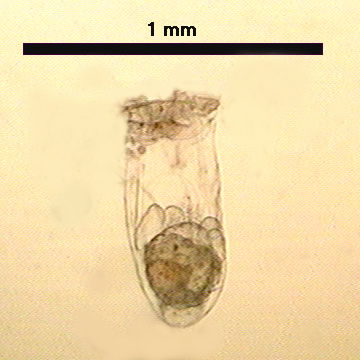
Asplanchna brightwelli
 
Phylum Rotifera
Class Monogononta
Order Ploima
Family Asplanchnidae
 
Distinguishing Characteristics
  • Foot not present
  • Lobes in stomach
  • U-shaped vitellarium
  • Asplanchna subgenus is characterized by a “horseshoe-shaped yolk gland”(4)
Comparison of Similar Species
 
    Asplanchna brightwelli, Asplanchna intermedia, and Asplanchna sieboldi can be compared by their polymorphism and sexual reproduction (4). Tocopheral (vitamin E) in body tissue is required for these three species to reproduce sexually (4). When tocopheral is not present in diet, all females are saccate (sac-shaped) and reproduce by diploid, parthenogenesis (amictic) (4). After consuming tocopheral in prey items, the saccate females produce female offspring that are larger and have outgrowths (4). These outgrowths protect the females from cannibalism (4). These outgrowths are extended by hydraulic pressure when the rotifer draws-in its corona. This feature increases the animal's size and difficulty in handling when attacked by predator (4).
    These three species exhibit polymorphism; each generation's morphotype is determined by the tocopheral level in tissue metabolized by the prey consumed by its mother (4). The tree different morphotypes are saccate, cruciform, and campanulate (show figure explaining) (4) These morphotypes are determined at birth (4).
    A. brightwelli is the most ancestral of the three species. When tocopheral is “above-threshold levels” in body tissue the next generation will have only slight outgrowths but a much larger size (4).
    A. intermedia, without tocopheral is saccate form; “above-threshold levels” of tocopheral is cruciform; when “above-threshold level” and mother consumed congeneric prey (cannibalism) the morphotype is campanulate (4). The cruciform morphotype of this species can be either mictic or amictic (4).
    A. sieboldi, the most advanced of the three, is more responsive to tocopheral (Gilbert, 1975a, 1975b). the outgrowths are more pronounced and sexual reproduction is related to the size of outgrowths (4). The campanulate form in A. sieboldi is larger than in A. intermedia and can be either mictic or amictic also the campanulate form can also produce cruciform offspring when tocopheral and congeneric prey levels are at threshold (4). The campanulate morphotype is less frequently produced in A. sieboldiand can be either mictic or amictic therefore this species has the most varied reproduction strategy of the three (4).
    As a comparison, Asplanchna girodi is a rotifer that does not exhibit polymorphism. A. girodi mostly consumes algae and usually inhabits water containing less organic matter (4). Because this species is not cannibalistic there is no selective pressure to increase size. Increased size would be detrimental because it would reduce the ability to consume small algae(4); size of food item is correlated with corona opening.

 
Geographic Distribution
 
    Aspanchna brightwelli are found in the United States in temperate areas, such as the northeast region. They have also been found in the warmer climes of Florida (1).
 
Reported Habitats
 
A. brightwelli live in alkaline, eutrophic lakes and ponds (3).
 
Food and Feeding Behavior
 
    A. brightwelli is a carnivorous rotifer that feeds on smaller rotifers and ciliates, as well as several colonial algal species (3). Asplanchna females are the largest and most voracious of the rotifers (4).
 
Effects on Prey
 
In the presence of A. brightwelli, Keratella valga slacki develop a larger body size and longer anterior spines to deter predation (2).
 
Reproductive Habits
 
    Rotifer sexual reproduction can be triggered by length of photoperiod or population densities although the cue for Asplanchna spp. Mictic reproduction is levels of Tocopheral (vitamin E) accumulated in body tissue (4).
    A. brightwelli females can reproduce sexually for brief periods but usually reproduce parthenogenetically (3)(4). During the sexual reproduction phase, mictic females produce eggs having two polar bodies upon maturity. If these eggs are unfertilized (haploid and parthenogenitically produced) they develop into males. If fertilized the eggs (diploid) develop into thick-walled resting eggs (3). These resting eggs hatch into amictic females (3).
    A. brightwelli can be either “long-lived” or “short-lived”, depending on both their genotype and the temperature of their environment (1). ong-lived A. brightwelli have a low rate of reproduction over a longer period (1). Short-lived individuals produce many offspring over a shorter period (1). While the short-lived A. brightwellireproduce at a higher rate the long-lived individuals produce more offspring over time (1). It is energetically costly to reproduce many offspring over a short period but there is a high risk of mortality when older females reproduce (1).
 
Geographic Distribution
 
    Aspanchna brightwelli are found in the United States in temperate areas, such as the northeast region. They have also been found in the warmer climes of Florida (1).
 
Additional Pictures
         
Quicktime Movies
Links